
There are six major tournaments called honbasho held in Japan annually—one on each odd-numbered month—and they take place over a 15-day period at one of four different venues across the country.
- January: Tokyo (Ryogoku Kokugikan)
- March: Osaka (EDION Arena Osaka)
- May: Tokyo (Ryogoku Kokugikan)
- July: Nagoya (Dolphins Arena)
- September: Tokyo (Ryogoku Kokugikan)
- November: Fukuoka (Fukuoka Kokusai Center)
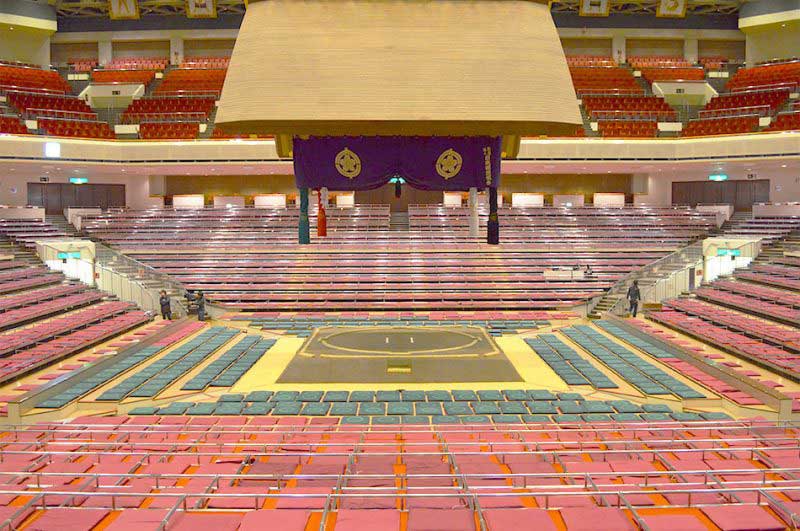
In Tokyo, these honbasho are held at Ryogoku Kokugikan in east Tokyo, a sporting venue mainly used for sumo events with a capacity of about 11,000. Like a boxing match, the seats all face the center ring—the dohyo—where each bout takes place. There are three main groups of seats, each offering a fundamentally different experience.
Ringside Seats《溜席》
These are the most prestigious seats in the house: ground-level cushions located directly around the ring. While they offer an unparalleled view, they come with strict protocols: no eating, drinking, or photography is permitted. There is also a genuine risk of injury, as wrestlers are frequently thrown from the ring into the first few rows of spectators. Note: For safety reasons, children under 4 are typically not permitted in this section.
Box Seats《枡席》
A small box area with 4-6 mats, charged on a per-box basis. There are three tiers (A, B, and C) based on proximity to the ring. While traditional and charming, these boxes are small once fully occupied. Crucially: In box seats, every individual (including infants) counts toward the capacity limit. Unlike ringside seats, you are free to eat, drink, and take photographs here.
Many spectators pre-order bento sets or head to the basement for the stadium’s famous yakitori (chicken skewers). In sumo, chicken is a lucky food because a chicken stands on two legs—symbolizing a wrestler staying upright. Touching the ground with any other part of the body is a loss, so four-legged animals are rarely served at the arena.
Chair Seats《椅子席》
Located on the 2nd floor, these are western-style stadium seats. They provide a clear, elevated view and are the most affordable option for pre-booking, with standard prices typically ranging from ¥3,800 to ¥9,500. Children under 4 may enter for free if they sit on a parent’s lap.
The Daily Schedule
A day of sumo is a 10-hour marathon, and understanding the timing is key to your visit:
- Morning (8:30am – 3:00pm): Lower-division matches. The stadium is quiet, making it the best time to explore and take photos.
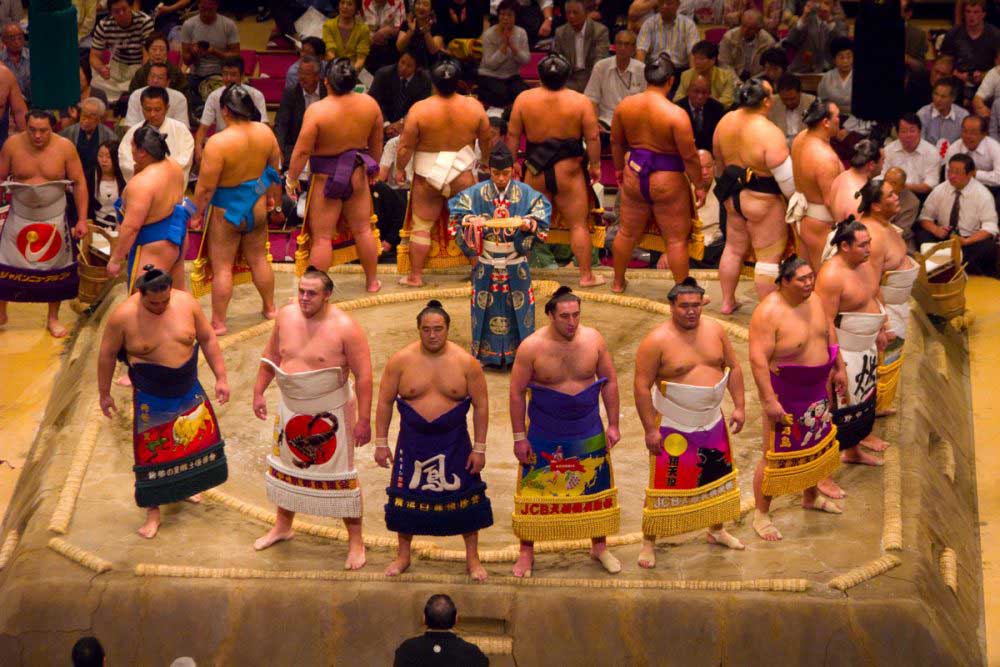
- The Ceremony (3:45pm): The Dohyo-iri (ring-entering ceremony) for the top-division wrestlers. This is a colorful, spiritual spectacle you should not miss.
- The Main Bouts (4:00pm – 6:00pm): The highest-ranking wrestlers compete during this window, culminating in the final match and the bow-twirling ceremony.
How do I buy tickets?
Tickets are sold via the official site (Ticket Oosumo), which has a full English interface. It is advisable to check the site months in advance for sale dates. There is typically a service fee of approximately ¥1,100 per ticket. There is rarely a need to use third-party agencies, as they often charge massive markups for the same access.
How quickly do tickets sell out?
Extremely quickly. Popular weekend dates and two-person boxes often sell out within hours of going live. If the site shows “Sold Out,” check back over the following 48 hours as cancelled transactions occasionally release tickets back into the system.
What if all the tickets are sold out?
All is not lost. General admission tickets are sold at the Ryogoku Kokugikan box office each morning for ¥2,200 (cash only). These are for the very back row of the 2nd floor. To secure one, join the queue at the stadium before 6:00am; only about 350 tickets are available daily.
You can read more about sumo—the history and the rules—in this post.