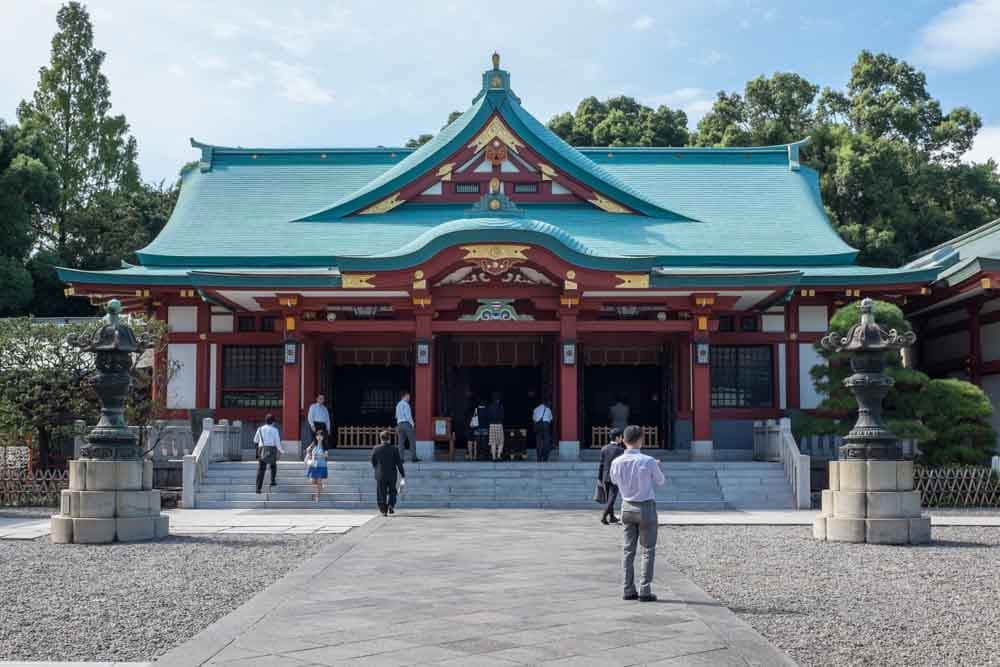
Hie Shrine
Perched on a hill in the heart of the Akasaka business district, Hie Shrine (日枝神社) serves as a grand spiritual anchor amidst Tokyo’s modern skyscrapers. The shrine was originally established in 1478 by the regional lord Ota Dokan—the visionary architect of Edo Castle—to enshrine the spirit of the Sanno Shrine from Kawagoe. Its primary purpose was to act as the supreme protector of the city. Like much of the capital, the original structures were lost in the Great Fire of Meireki in 1657. It was rebuilt in 1659 by Tokugawa Ietsuna at its current location, specifically chosen because the elevated ground allowed the Shogun to view the shrine directly from the ramparts of Edo Castle.
Although the main buildings were once again leveled during the air raids of 1945, the 1958 reconstruction maintains the regal atmosphere of its Tokugawa-era peak. One of the shrine’s most distinctive features is its unique choice of guardians. Instead of the typical komainu (lion-dogs) found at most Shinto sites, Hie Shrine is guarded by statues of monkeys, known as Masaru. These primates are considered messengers of the Sanno deity; the name Masaru is a play on words meaning both “to excel” and “to drive away demons,” making the shrine a popular destination for those seeking success in business or protection from misfortune.
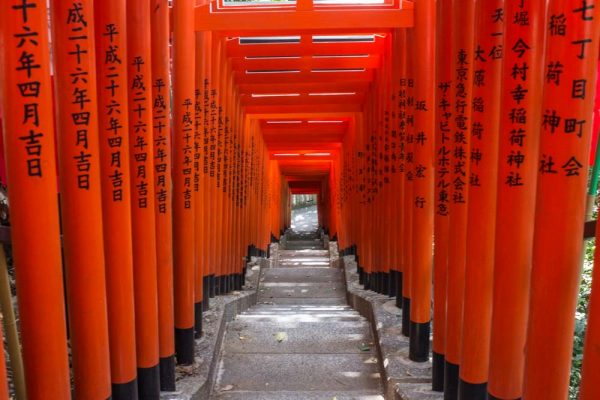
The approach to the shrine offers a fascinating contrast between ancient and modern Tokyo. While traditionalists may prefer the steep stone steps, many visitors utilize the outdoor escalators—a rare and surprisingly practical addition for an urban shrine. For those seeking a classic visual experience, the Inari entrance on the west side of the hill features a winding path of bright red torii gates, reminiscent of the famous Kyoto landmarks, providing a photogenic and tranquil ascent to the sanctuary.
Hie Shrine is also the custodian of 14 Important Cultural Assets and a National Treasure—the Itomaki-no-Tachi, a masterfully crafted long sword. Its cultural weight is felt most strongly in mid-June during the Sanno Matsuri. As one of the three “Great Festivals of Edo,” it was historically the only festival permitted to enter the grounds of Edo Castle, where the Shogun himself would review the parade. Today, the festival remains a massive event, featuring a 300-meter long procession of portable shrines and floats that weave through the glass-and-steel canyons of central Tokyo.
| Visitor Information | |
|---|---|
| Address | 2-10-5 Nagatacho, Chiyoda-ku, Tokyo 100-0014 (Google Maps) |
| Opening Hours | 6:00 AM – 5:00 PM (Oct–Mar) / 6:00 PM (Apr–Sept) |
| Price | Free admission to the shrine grounds. |
| Website | Official Website |
| Access | ||
|---|---|---|
| Station | Line(s) | Details |
| Akasaka-mitsuke | Ginza / Marunouchi Lines | 3-minute walk from Exit 11. |
| Tameike-sanno | Ginza / Namboku Lines | 3-minute walk from Exit 7. |
| Kokkai-gijidomae | Chiyoda Line | 5-minute walk from Exit 5. |