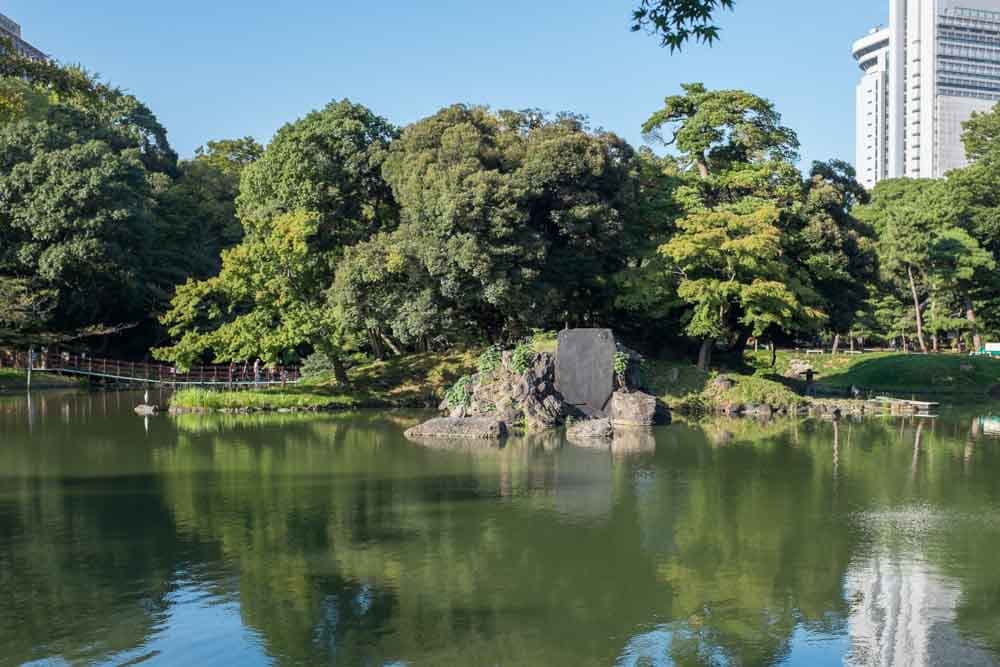
Koishikawa Korakuen Garden
Dating back to the early 17th century, Koishikawa Korakuen is one of Tokyo’s most spectacular gardens. Designed by Mito Yorifusa, a feudal lord, and completed by his successor, Mito Mitsukuni, the gardens were specifically designed to recreate famous Chinese scenes, Mitsukuni being a strong follower of Confucian ideas. Even the name, Korakuen (which translates as “enjoying afterwards garden”), is taken from the Chinese teaching that an emperor “should feel sorrow before his people do but feel enjoyment only after them”. This philosophical “vibe” is evident in landmarks like the Seiko-no-tsutsumi, a stone embankment designed to mirror the West Lake in Hangzhou, China.
In 1952 the garden was designated a Special Historic Site and Place of Natural Beauty by the Cultural Assets Preservation Act and thus today stands protected alongside the likes of Itsukushima and Kyoto’s Kinkakuji. Among its most celebrated features is the Engetsu-kyo, or “Full Moon Bridge.” This 17th-century stone structure was designed so that the bridge and its reflection in the water below form a perfect, luminous circle. Such intricate planning provides an architectural lull where intellectual history and natural aesthetics converge, offering a glimpse into the sophisticated tastes of the Mito branch of the Tokugawa clan.
The garden is popular all year round, but gets especially crowded in late November and early December when the leaves of the maple trees around the main pond turn red. In the spring, the garden’s weeping cherry trees and plum grove offer a more delicate color palette. The garden is otherwise extremely tranquil; however, if you happen to visit during the staging of a sports event at the nearby Tokyo Dome, the din of the crowd will abruptly remind you that you are still in the center of the city. This juxtaposition between the ancient, meditative garden and the modern high-energy stadium serves as a resolute guardian of Tokyo’s multifaceted urban identity.
| Visitor Information | |
|---|---|
| Address | 1-6-6 Koraku, Bunkyo-ku, Tokyo 112-0004 (Google Maps) |
| Opening Hours | 9:00 AM – 5:00 PM (Last entry 4:30 PM) |
| Price | ¥300 (approx.) |
| Website | Official Website |
| Access | ||
|---|---|---|
| Station | Line(s) | Details |
| Iidabashi Station | JR Chuo-Sobu / Subway | 8-minute walk from the East Exit (JR) or Exit C3 (Subway). |
| Korakuen Station | Marunouchi / Namboku Lines | 8-minute walk from Exit 4A. |