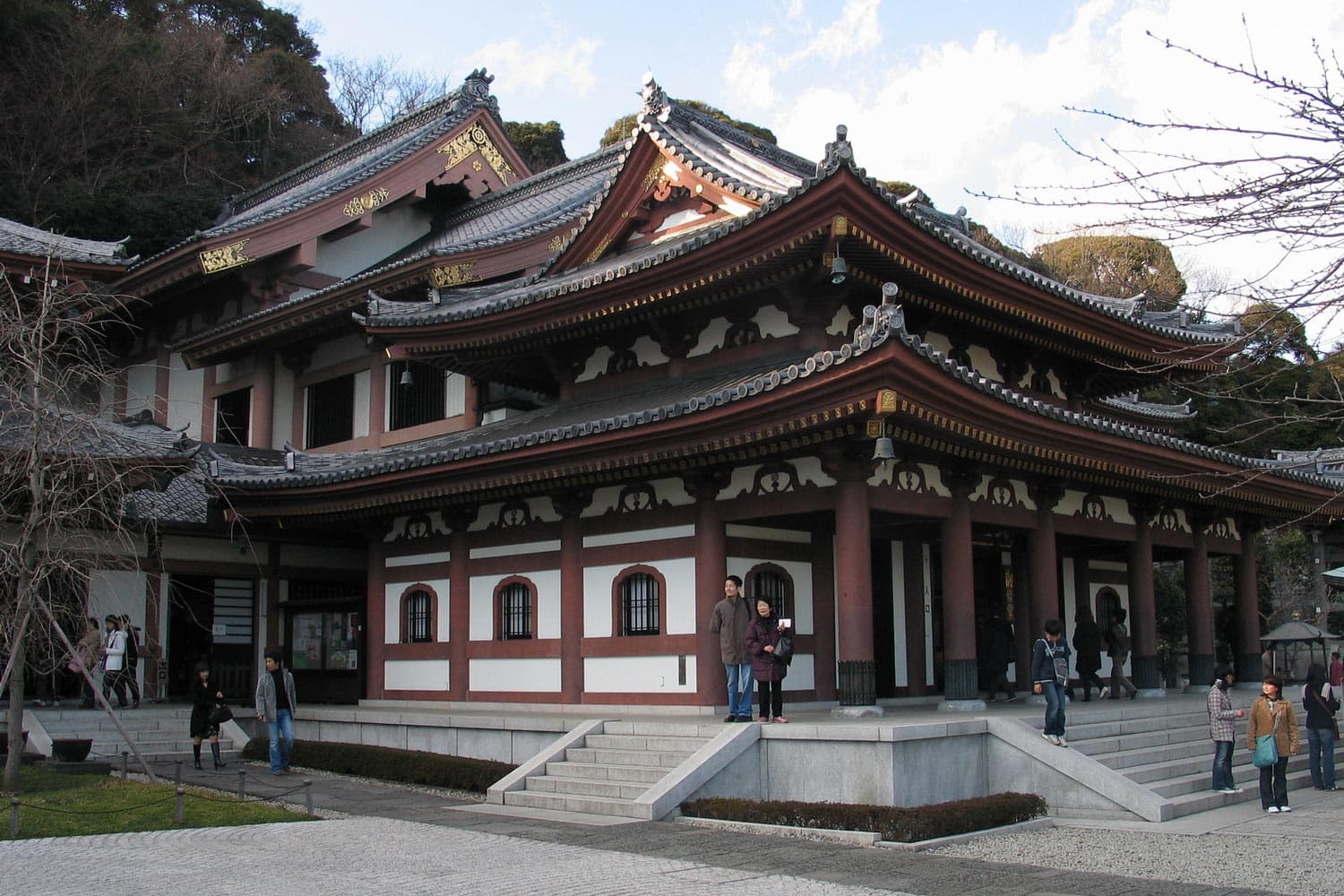
Hasedera Temple
Hasedera Temple (長谷寺) is one of the most significant and visually stunning Buddhist complexes in Kamakura. Established according to legend in 736 CE, the temple is built into the side of a hill overlooking the sea. It is most famous for its massive eleven-headed statue of Kannon, the Bodhisattva of Mercy. This 9.18-meter-tall masterpiece is one of the largest wooden statues in Japan and was reportedly carved from a single, gargantuan camphor tree. Legend states that two statues were carved from the same trunk; one was enshrined in Nara, while the other was cast into the ocean with a prayer that it would reappear to save the people. It washed ashore at Nagai on the Miura Peninsula and was subsequently moved to its current home in Kamakura.
The Main Hall and the Sacred Cave
The centerpiece of the complex is the Kannon-do Hall, which houses the gold-leaf-covered statue. The eleven heads represent the deity’s ability to look in all directions to assist those in need. Adjacent to the main hall is the Amida-do Hall, featuring a seated protector Buddha, and the Jizo-do Hall. This area is particularly moving, as it is surrounded by thousands of small stone Jizo statues. These represent Sentai Jizo, placed by parents as memorials for lost children. Over time, these figures have become a defining feature of the temple’s landscape, often adorned with red bibs and hand-knitted caps provided by devotees.
For those seeking a more immersive experience, the Benten-kutsu is a must-visit. This small, winding cave is dedicated to Benzaiten, the goddess of feminine beauty and wealth. Inside, the low-ceilinged tunnels are illuminated by candlelight, revealing dozens of small carvings of the goddess and her sixteen followers directly into the rock walls. The atmosphere within the cave is distinctly different from the airy gardens above, offering a quiet, subterranean space for prayer and reflection.
Coastal Views and Seasonal Blooms
Hasedera is as much a botanical garden as it is a religious site. The lower levels feature traditional stroll gardens with ponds filled with koi and manicured maple trees. However, it is the Ajisai-michi (Hydrangea Path) that draws the largest crowds. During June, over 2,500 hydrangea plants of 40 different varieties bloom simultaneously, turning the hillside into a sea of blues, purples, and pinks. In the autumn, the temple is equally famous for its maple foliage, often staying open late for special night-time illuminations that reflect in the ponds below.
The temple’s upper observation deck provides what is arguably the best view in Kamakura. From here, visitors can look out over the crescent-shaped Yuigahama Beach and the expanse of Sagami Bay. This proximity to the ocean, combined with the temple’s rich history and diverse architectural features—including a high-tech Kannon Museum—makes Hasedera a comprehensive cultural destination. Whether visiting for the profound spiritual history of the Kannon statue or the photogenic “Nagomi Jizo” statues hidden throughout the gardens, it remains a cornerstone of the Japanese temple experience.
| Visitor Information | |
|---|---|
| Address | 3-11-2 Hase, Kamakura, Kanagawa 248-0016 (Google Maps) |
| Opening Hours | 8:00 AM – 5:00 PM (Mar–Sept) / 8:00 AM – 4:30 PM (Oct–Feb) Closed: Open daily |
| Price | Adults: ¥400 / Elementary Students: ¥200 |
| Website | Visit Website |
| Access | ||
|---|---|---|
| Station | Line | Access Details |
| Hase Station | Enoshima Electric Railway (Enoden) | 5-minute walk |
| Kamakura Station | JR Yokosuka Line | Transfer to Enoden or a 25-minute walk |