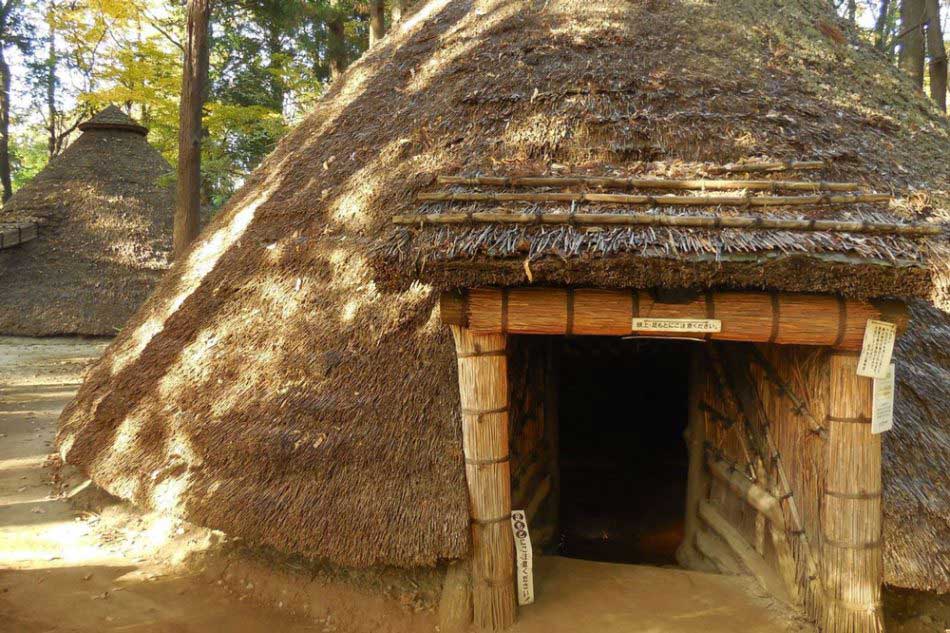

The first humans to inhabit Japan walked over from the mainland around 35,000 BCE at a time when the northwestern tip of Hokkaido was connected to the eastern extremities of Russia. Evidence of cord-marked pottery and the foundations of a basic society gave rise to Japan’s first documented period—the Jomon period. The Jomon were largely a hunter-gatherer culture who subsisted for more than 10,000 years before a more advanced people, the Yayoi, sailed over the narrow sea from the Korean peninsula around 500 BCE. These newcomers gradually came to dominate the regions from the south of Japan up to northern Honshu; today, it is understood that the Japanese people are descendants of interbreeding between these two early inhabitants.
The following centuries witnessed the emergence of a basic social structure, primitive bronze and iron tools, and farming techniques, with rice cultivation being the most notable. Piecing together archaeological fragments to form an accurate picture of Japanese society at this time is challenging because no written documents exist from within Japan. The only records we have before the 8th century come from Chinese texts, which refer to a country called “Wa” in the east. By 250 CE, a ruling state had emerged which held control over the land from northern Kyushu to the Kanto plains, ruling from modern-day Nara Prefecture.
These early centuries also witnessed Shinto (“way of the gods”) take root. As a religion indigenous to Japan, Shinto followers worship multiple kami (gods or spirits) who reside in natural objects like mountains, trees, and rocks. For a people whose existence depended heavily on the rice harvest, the evolution of a nature-centric religion was a logical development. The title of emperor likely evolved from the position of Shinto chief priest. Folklore holds that the first emperor descended from the sun goddess, Amaterasu. This notion of divine descent persisted for millennia, eventually leading the U.S. to require Emperor Hirohito to formally declare his humanity in the aftermath of World War II.
Japan’s other main religion, Buddhism, arrived from Korea in the mid-6th century when King Seong of Baekje sent a mission to Nara bearing a statue of the Buddha and copies of the sutras. Buddhism struggled initially; a plague was attributed to the offense of a native sun goddess, and the statue was thrown into the sea. However, the adoption of Buddhism by the powerful Soga clan became the greatest catalyst for the propagation of the religion throughout Japan.
While Shinto and Buddhism shaped spiritual beliefs, the teachings of Confucius provided the framework for the administrative and legal systems. The Seventeen-Article Constitution authored by Prince Shotoku in 604 CE and the subsequent Taika Reforms in 645 CE established Japan’s first constitutional foundations. Based on the ritsuryo system of penal and administrative codes, these reforms emphasized patriarchal rule and laid the groundwork for a male-dominated society.
At the beginning of the Heian period (794–1185), the subjugation of the northern Emishi people—descendants of the Jomon who had remained outside government influence—brought further unification. The capital relocated from Nara to Heian-kyo (present-day Kyoto), where it remained until 1868. This era saw a proliferation of art and culture, including The Tale of Genji—often considered the world’s first modern novel—and the flowering of waka poetry. However, the period is best known for the gradual rise of the samurai class.
The image of a central government in Kyoto does not fully reflect the political reality of the time. Powerful warlords with private armies dominated the regions outside the capital. Following the end of conscription in 792 CE, the emperor was forced to rely on these clans to quash rebellions. This weakening of central power is evidenced by the shoen system. Although the ritsuryo codes declared all land to be government property, shoen were tax-free estates granted to those who pledged allegiance to the emperor. By the 12th century, roughly half of Japan’s arable land was classified as shoen, severely eroding the government’s revenue.
The unique power dynamic between the ruling clans and the emperor explains why the emperor remained the nominal head of Japan despite centuries of internal power struggles. Because the emperor was believed to be a direct descendant of Amaterasu, he provided the religious and mythological legitimacy required by any ruling government. To depose the emperor would be to invalidate the ruler’s own right to govern. Thus, the emperor remained protected by a “mythological cloak” that no warlord dared to pierce.
As the balance of power shifted, the Kyoto government became a passive observer of regional struggles. A succession dispute in 1155 triggered a decades-long conflict that ended with Minamoto no Yoritomo establishing the Kamakura bakufu—Japan’s first shogunate. In 1192, he received the title of seii-taishogun from Emperor Go-Toba. The samurai would remain the de facto rulers of Japan for the next 700 years until the Meiji Restoration in 1868.
- Next: Samurai Rule & Civil War