
In the late 17th century, Honjo Inabanokami Munesuke, a powerful clan leader, received this plot of land from the shogunate to serve as his suburban residence. He utilized the space to construct a traditional strolling pond garden in a style that closely resembled the nearby Kiyosumi Gardens. Today, Former Yasuda Garden (Kyū-Yasuda Teien) stands as a quiet pocket of Edo-period aesthetics tucked behind the industrial and sporting hubs of Ryogoku.
The Heart-Shaped Pond and Tidal Innovation
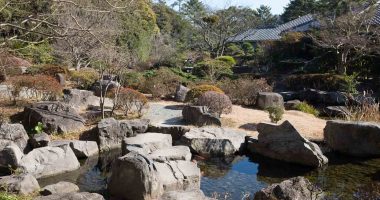
The defining feature of the site is the central pond, known as Shinji-no-ike. While often described as heart-shaped, the pond is technically designed in the shape of the kanji character for “heart” or “spirit” (心). Historically, the garden was celebrated as a shio-iri-no-niwa—a tidal garden. It was connected directly to the Sumida River, allowing the water levels to rise and fall naturally with the tides, a rare engineering feat that provided a constantly shifting landscape.
Due to modern water pollution and the construction of flood-control floodgates along the Sumida River, this direct connection is no longer possible. However, the garden maintains its tidal heritage through an artificial system. An underground tank and pump mechanism simulate the ebb and flow of the tide twice a day, preserving the movement of the water and the specific ecosystem of plants and stone arrangements that were originally designed to be submerged and revealed throughout the day.
A Legacy of Resilience and Modern Contrast
The garden was re-modeled in 1894 by Zenjiro Yasuda, the founder of the Yasuda financial group. Following his death, the estate was granted to the city in 1922, but the transition to a public park was interrupted by the Great Kanto Earthquake of 1923, which almost entirely destroyed the grounds. It was reconstructed and finally opened in 1927, only to suffer further damage during the firebombing of the city in 1945. It was not until 1971 that the garden was fully restored to its original condition.
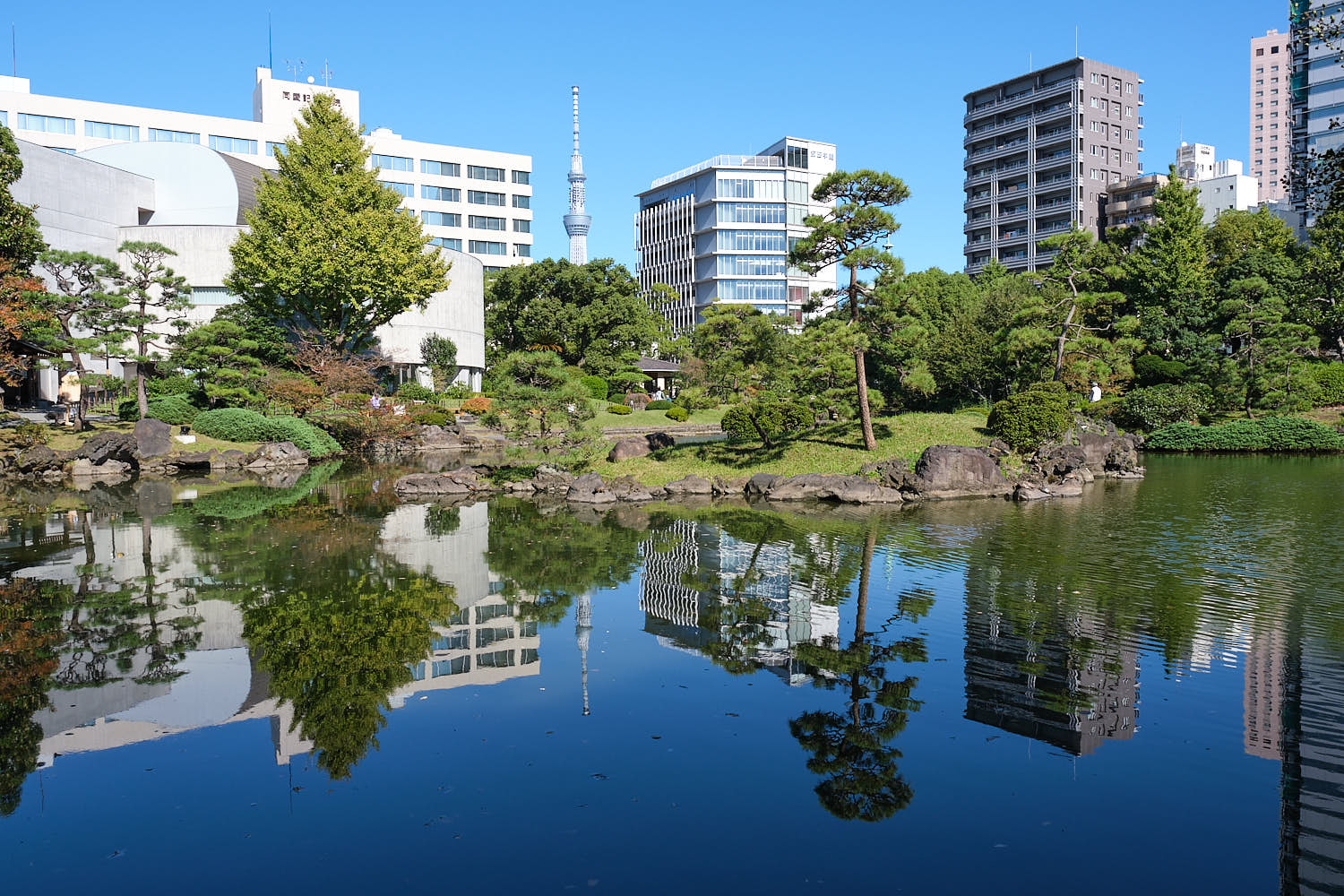
One of the most compelling reasons to visit the garden today is the juxtaposition of eras. Because the garden is located directly between the Ryogoku Kokugikan and the river, it offers one of the most famous viewing angles of the Tokyo Skytree. The reflection of the ultra-modern tower in the still, character-shaped waters of Shinji-no-ike creates a visual bridge between the shogunate’s suburban retreat and the high-tech skyline of 2026. Despite its proximity to major tourist attractions, the garden remains relatively overlooked, making it one of the most peaceful spots in the district for those looking to escape the city’s noise.
| Visitor Information | |
|---|---|
| Address | 1-2-1 Yokoami, Sumida-ku, Tokyo 130-0015 (Google Maps) |
| Opening Hours | 9:00 AM – 4:30 PM Closed: Year-end/New Year (December 29 – January 1) |
| Price | Free |
| Website | Visit Website |
| Access | ||
|---|---|---|
| Station | Line(s) | Access Details |
| Ryogoku Station | JR Sobu Line | West Exit (5-minute walk) |
| Ryogoku Station | Toei Oedo Line | Exit A1 (5-minute walk) |