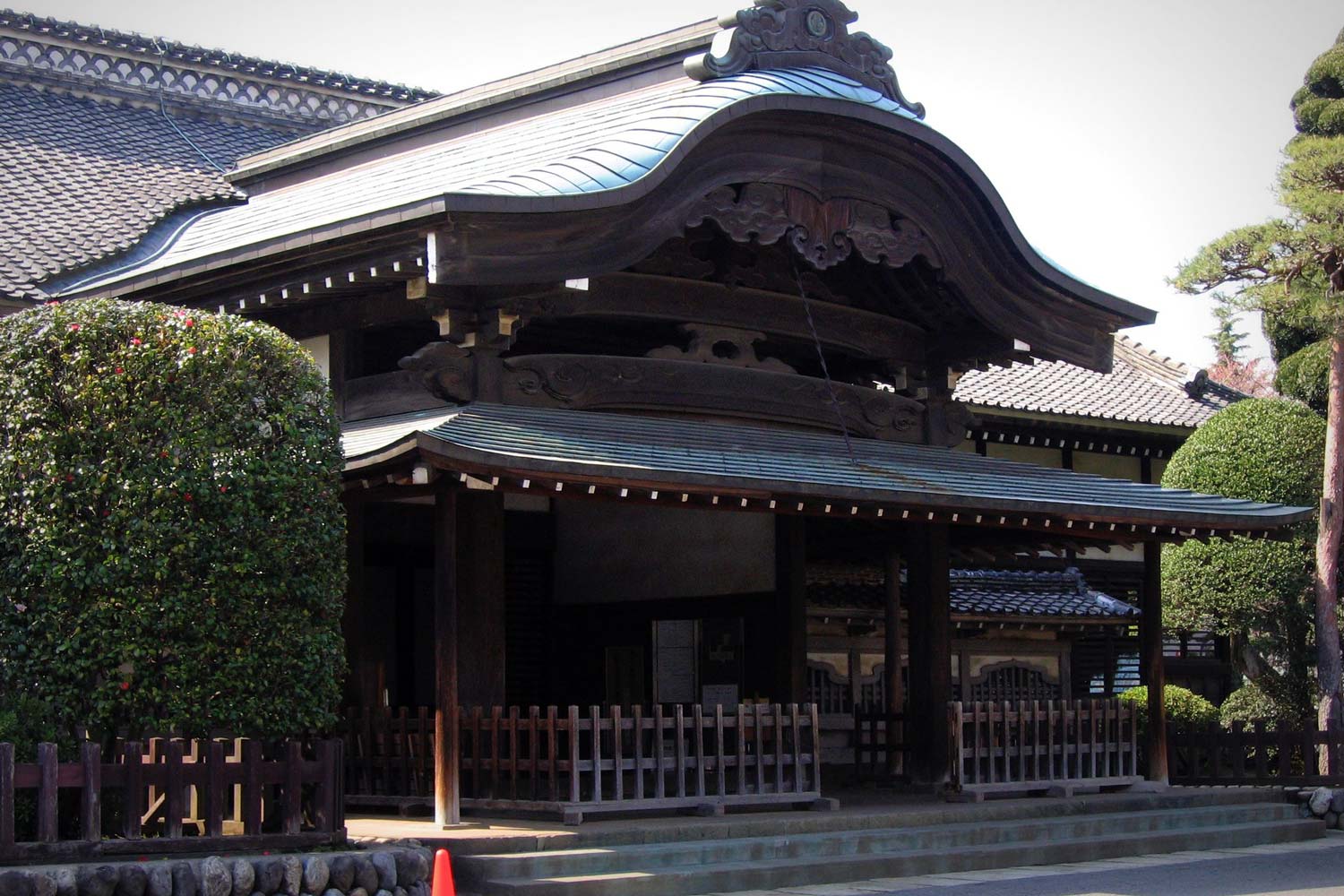

The Honmaru Goten is a rare surviving example of a feudal lord’s palace and the only remaining structure of the original Kawagoe Castle. During the Edo period, the Tokugawa shogunate viewed Kawagoe as a vital defensive bastion for the northern approaches to Edo (modern-day Tokyo). Consequently, the castle was overseen by high-ranking fudai daimyo—lords who were hereditary vassals of the Tokugawa. While most Japanese castles are recognized by their towering stone walls and wooden keeps, the Honmaru Goten represents the living quarters and administrative heart where the daily business of the domain was conducted.
Architectural Resilience and the Grand Entrance
The current structure dates back to a reconstruction in 1848 by the daimyo Matsudaira Naritsune. What remains today is only a fraction of the original sprawling complex, yet it still preserves the most significant ceremonial spaces. Visitors enter through the Genkan, a grand entrance hall characterized by wide, polished wooden floorboards and massive beams designed to impress visiting dignitaries. The interior is a labyrinth of spacious tatami rooms separated by elegantly painted fusuma (sliding doors). One of the most evocative areas is the Karo-no-ma (Old Elders’ Room), which features period-dressed mannequins depicting a meeting between a feudal lord and his high-ranking advisors, providing a vivid snapshot of Edo-period political life.
Simplicity and Zen Aesthetics
In contrast to the grand ceremonial halls, the palace also contains intimate spaces designed for reflection. A small, minimalist Zen garden is nestled within the inner courtyard, designed to be viewed from the surrounding wooden engawa (veranda). The simplicity of the garden, with its carefully placed stones and raked gravel, reflects the aesthetic sensibilities of the samurai class, who balanced their martial duties with an appreciation for refined culture. Walking through the quiet, echoing corridors of the Honmaru Goten offers a profound sense of the stoic and ordered world of the 19th-century Japanese elite, making it an essential stop for any historical exploration of the “Little Edo” district.
| Visitor Information | |
|---|---|
| Address | 2-13-1 Kuruwamachi, Kawagoe, Saitama 350-0062 (Google Maps) |
| Opening Hours | 9:00 AM – 5:00 PM (Last admission 4:30 PM) Closed: Mondays (unless a holiday), 4th Friday of the month, and Dec 29 – Jan 3 |
| Price | Adults: ¥100 / Students: ¥50 |
| Website | Visit Website |
| Access | ||
|---|---|---|
| Station / Stop | Line / Bus | Access Details |
| Honmaru Goten Stop | Co-Edo Loop Bus | Directly outside the entrance |
| Kawagoe Station | JR Kawagoe Line / Tobu Tojo Line | 10-minute bus ride or 30-minute walk |
| Hon-Kawagoe Station | Seibu Shinjuku Line | 20-minute walk through the warehouse district |