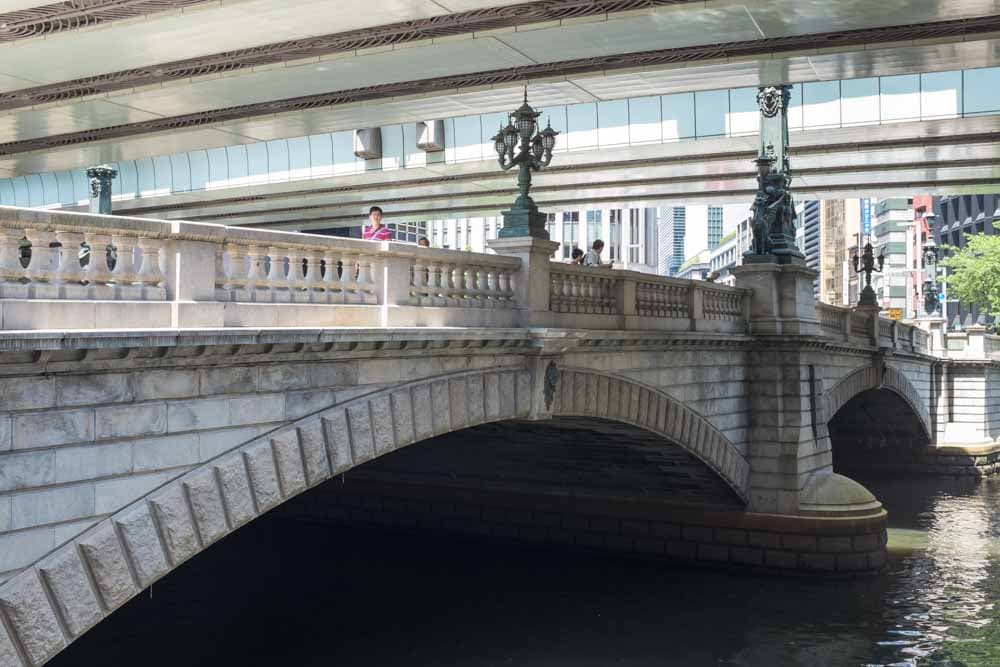
Nihombashi
If you had to mark the heart of Tokyo—and by extension, the heart of Japan—a strong case could be made for Nihombashi (日本橋). In 1601, the Tokugawa Shogunate began the construction of the Five Routes (Gokaido), a massive network of highways designed to connect the capital with the outer provinces. Nihombashi was designated as the starting point for all five routes, making it the literal point from which all distances in Japan were measured. This intersection of travelers and merchants transformed the area into a thriving commercial powerhouse that has remained a resolute guardian of Japanese prestige for over four centuries.

The name “Nihombashi” translates literally to “Japan Bridge.” While previous wooden incarnations were frequently lost to the fires of Edo, the current twin-arched stone structure has stood since 1911. Miraculously surviving the Great Kanto Earthquake and the air raids of WWII, the bridge is a high-fidelity masterpiece of Meiji-era design, featuring bronze statues of Kirin (mythical winged creatures) that symbolize the city’s ambition. In the center of the roadway remains the Zero Milestone marker, the official coordinate for measuring national road distances. For decades, the bridge’s beauty was obscured by a massive elevated expressway, but a landmark civil engineering project is currently rerouting the highway underground, a feat of technical ingenuity aimed at finally returning the “view of the sky” to this historic landmark.
The Zero Milestone and the Reclaiming of the Sky
This commitment to revitalization has recently expanded to the water itself. In 2026, the area saw the launch of the &CRUISE project, Japan’s first regular service of fully electric passenger vessels connecting Nihombashi to Toyosu. This waterway transport provides a sophisticated architectural lull for commuters and visitors, allowing them to feel the river breeze while navigating between the district’s storied merchant roots and its modern skyline. At the center of this commerce is Mitsukoshi Nihombashi, Japan’s oldest and most prestigious department store. Originally founded as a kimono shop in 1673, its main building features a stunning central atrium and a pipe organ that performs recitals on weekends, bridging the gap between Edo-era service and modern luxury.
Complementing this grand history is the Coredo Muromachi complex, a series of modern buildings designed to evoke the atmosphere of an Edo-period merchant street. It houses many of Nihombashi’s legendary shops that have operated for hundreds of years, specializing in artisanal goods such as washi paper and dashi. Furthermore, the district remains the traditional financial center of Japan, home to the Bank of Japan and the Tokyo Stock Exchange. From the “yen-shaped” architecture of the central bank to the high-energy trading floors, Nihombashi remains as vital to the nation’s economy today as it was during the time of the shoguns.
| Station | Lines | Best For… |
|---|---|---|
| Nihombashi | Ginza, Tozai, Asakusa Lines | The Bridge, Mitsukoshi, Coredo |
| Mitsukoshimae | Ginza, Hanzomon Lines | Bank of Japan, Coredo Muromachi |
| Tokyo Station | JR Lines, Shinkansen | 10-minute walk to the South Area |


