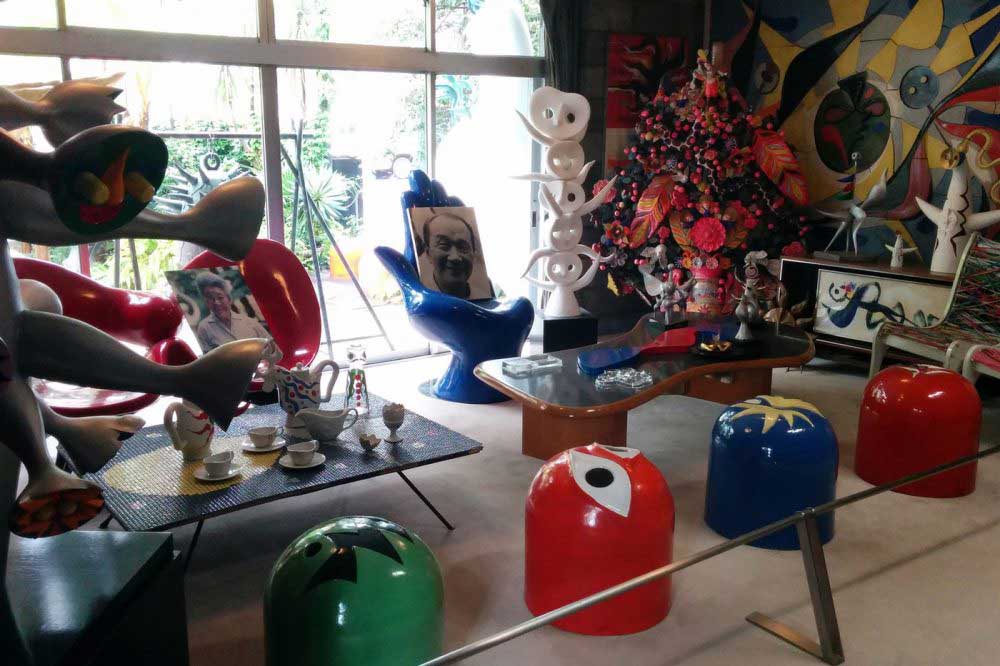

This museum is the former home and studio of Okamoto Taro (1911–1996), whose surreal and avant-garde style was heavily influenced by his decade in Paris during the 1930s. Tucked away in the stylish backstreets of Minami-Aoyama, the museum preserves the high-energy “lull” of Okamoto’s creative process. Unlike sterile galleries, this space feels alive; the studio remains exactly as he left it, with paint-splattered floors and unfinished canvases that capture the chaotic brilliance of the man who famously proclaimed, “Art is Explosion!”
The facility is a multi-sensory experience, featuring a whimsical garden where bronze sculptures peeking out from dense subtropical foliage seem to watch visitors as they pass. Inside, life-sized figures of the artist are interspersed among his iconic works, including drafts for the legendary “Tower of the Sun” and “Myth of Tomorrow.” The second floor hosts rotating exhibitions that dive deeper into his prolific career as a painter, sculptor, and writer. It is a rare opportunity to step directly into the mind of a visionary who spent his life challenging the boundaries of Japanese art and society.
| Visitor Information | |
|---|---|
| Address | 6-1-19 Minami-Aoyama, Minato-ku, Tokyo 107-0062 (Google Maps) |
| Opening Hours | 10:00 AM – 6:00 PM (Last entry 5:30 PM) Closed: Tuesdays (Open if holiday, closed next day) |
| Price | ¥650 (Adults) / ¥300 (Students) / Free for Elementary school & under. |
| Website | Official Website |
| Access | ||
|---|---|---|
| Station | Line(s) | Details |
| Omotesando Station | Chiyoda, Ginza, Hanzomon Lines | 8-minute walk from Exit B1 or B3. |