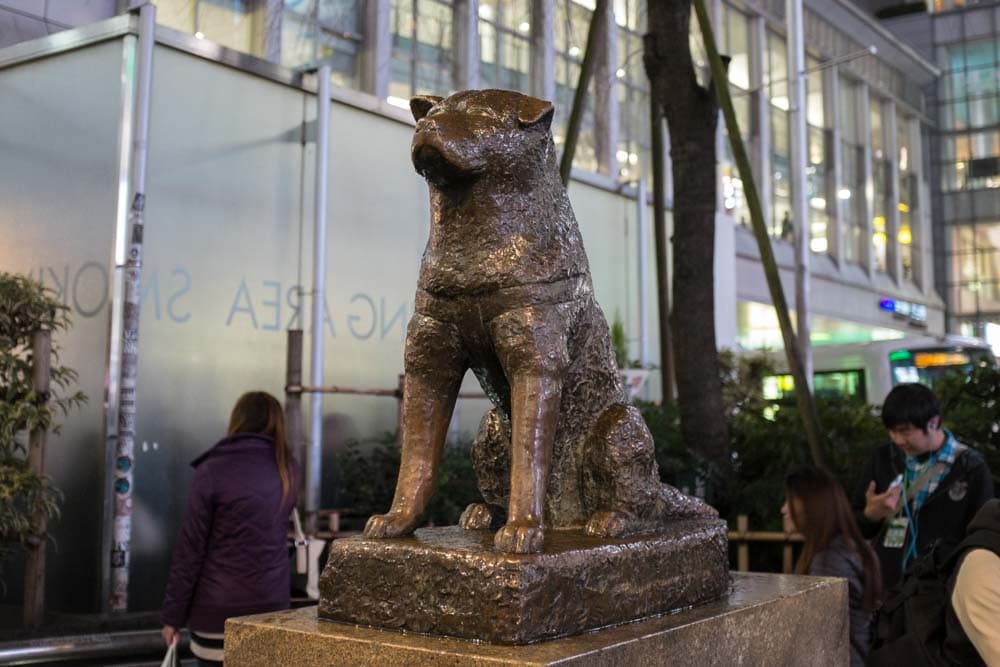
Hachiko Memorial Statue
Tokyo’s most famous resident isn’t a politician or a pop star, but a small bronze Akita named Hachiko. Standing guard outside the namesake Hachiko Exit of Shibuya Station, this modest monument is the heartbeat of the district. While the nearby Shibuya Scramble Crossing serves as a global symbol of Tokyo’s relentless motion, the statue of Hachiko represents the opposite: an immovable, unwavering stillness. For millions of commuters and travelers, “meeting at Hachiko” is the primary ritual of navigating the city, making it the most legendary landmark in the metropolis.
A Nine-Year Vigil of Loyalty
The true power of the monument lies in the tragic story of the dog it depicts. In the early 1920s, Hachiko was the companion of Hidesaburo Ueno, a professor at Tokyo Imperial University. Every morning, Hachiko would walk with the professor to Shibuya Station, and every evening at precisely the same time, he would be waiting at the ticket gate to welcome him home. This peaceful routine was shattered in May 1925 when Professor Ueno suffered a fatal brain hemorrhage while delivering a lecture. He never returned to the station. However, Hachiko did. For the next nine years, nine months, and fifteen days, the faithful Akita returned to the same spot every evening, searching the faces of the crowds for a master who would never step off the train.
Hachiko’s presence eventually became a national sensation after a newspaper article in 1932 detailed his devotion. He became a symbol of the “spirit of loyalty” that was highly valued in Japanese culture, providing a quiet “lull” of sincerity in an increasingly modernized city. Even before his death in 1935, a bronze statue was erected in his honor at the station, with Hachiko himself reportedly present at the unveiling. The story’s universal appeal later reached global audiences through the 2009 Hollywood film “Hachi: A Dog’s Tale,” starring Richard Gere—a remake of the poignant 1987 Japanese original, Hachiko Monogatari.
The physical history of the statue is as dramatic as the story itself. During the height of World War II, Japan faced a severe shortage of raw materials, and the original bronze statue was melted down to be used for train parts—a move that occurred just one day before the Japanese surrender in 1945. However, the connection between the city and its dog was too strong to be forgotten. In 1948, a new statue was commissioned and cast by Takeshi Ando, the son of the original sculptor. Today, Hachiko continues his vigil, surrounded by a constantly evolving skyline of skyscrapers and digital billboards, reminding the people of Tokyo of the enduring power of a simple, unspoken promise.