Hakata Dontaku Port Festival
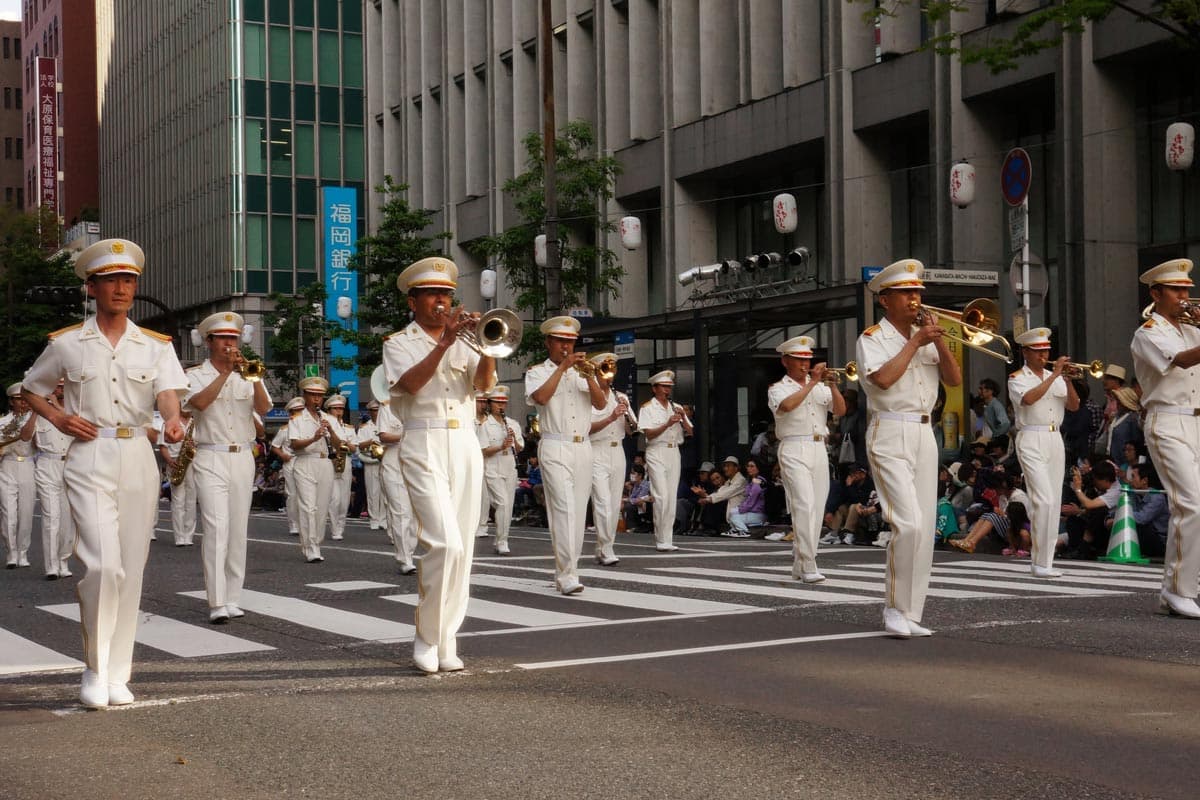
The Hakata Dontaku Port Festival (博多どんたく港まつり) is the centerpiece of Japan’s Golden Week, attracting over two million visitors to Fukuoka every May 3–4. The festival’s roots lie in the 1179 Hakata Matsubayashi, a New Year procession that was suppressed during the Meiji era before being revived as a massive secular celebration. Its unique name, “Dontaku,” is derived from the Dutch word Zondag (Sunday), reflecting the region’s historical role as a gateway for international trade and influence.
A defining feature of the parade is the rhythmic clicking of shamoji (wooden rice scoops). According to legend, this tradition began when a local housewife was so moved by the passing music that she joined the parade using the kitchen tools she was holding. Today, more than 30,000 participants across hundreds of troupes dance through the city streets. The spectacle is further elevated by hana jidosha—elaborately decorated floral floats that are beautifully illuminated after sunset. From the high-energy “Dontaku Square” on Meiji-dori to dozens of performance stages scattered throughout the city, the festival transforms Fukuoka into a sprawling, high-energy stage for traditional and contemporary arts alike.
The festival’s primary activities center around Meiji-dori, which is closed to traffic to form the main parade route. Access is most convenient via Tenjin or Nakasu-Kawabata stations, though visitors should expect extreme congestion throughout the downtown core. For a different perspective, the port area hosts its own series of maritime celebrations and special events. Given the massive crowds, it is recommended to arrive early to secure a spot along the parade route or at one of the larger outdoor stages. Many visitors also take the opportunity to sample local Hakata specialties at the numerous food stalls that line the city’s parks and riverbanks during the two-day event.
AddressFukuoka, Fukuoka, Japan (Google Maps)
CategoryJapanese Festivals
Japanese博多どんたく港まつり
Official URLOfficial websiteLink