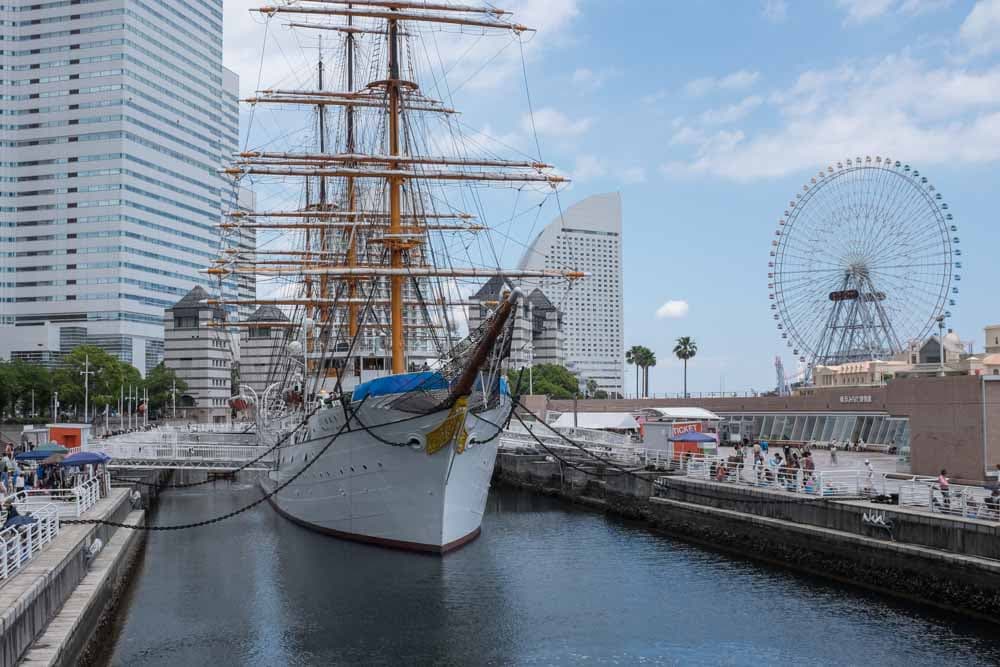
Nippon Maru Sail Training Ship
The Nippon Maru is a majestic four-masted barque that served as the primary training ground for Japan’s merchant marine for over half a century. Launched in 1930, she earned the affectionate nicknames “Swan of the Pacific” and “Lady of the Sea” due to her graceful white hull and the elegant profile she cut while under full sail. Permanently docked in the Minato Mirai district of Yokohama, the ship now serves as a preserved museum, offering a tangible connection to the golden age of sail-driven maritime education.
Life Beneath the Masts
During her 54 years of active service, the Nippon Maru logged a staggering 1.83 million kilometers—the equivalent of circumnavigating the globe more than 45 times. She was far more than a transport vessel; she was a floating classroom where over 11,500 cadets learned the rigorous arts of navigation, seamanship, and discipline. Visitors today can explore the meticulously preserved interior, which provides a vivid contrast between the hierarchical worlds of the crew. The upper decks house the captain’s day room and the officer’s saloon, featuring polished wood and leather upholstery that reflect the prestige of the senior staff. Conversely, the cadet’s quarters on the lower decks reveal the communal and cramped reality of life for students, with narrow bunks and shared mess halls that illustrate the camaraderie and hardship of ocean life.
The ship’s mechanical heart is equally impressive. Below deck, the original 600-horsepower diesel engines from 1930 remain in place, showcasing the transition period when sail ships began to incorporate reliable auxiliary power. The sheer complexity of the rigging is another highlight; the ship features 29 sails that were traditionally operated by hand. Approximately 12 times a year, the Nippon Maru is the site of a spectacular full-sail exhibition. During these events, a team of nearly 100 trained volunteers unfurls the massive sails, momentarily restoring the ship to her full seafaring glory and providing one of the most photographed sights in the harbor.
Cultural Heritage and the Port Museum
In 2017, the Nippon Maru was designated as an Important Cultural Property, cementing her status as a vital piece of national heritage. The ship is part of the broader Nippon Maru Memorial Park, which also includes the Yokohama Port Museum. This adjacent underground facility provides deeper historical context, tracking the evolution of Yokohama from a small fishing village into a global shipping hub. Together, the ship and museum offer a comprehensive look at the engineering, politics, and human stories that defined Japan’s maritime expansion. Whether exploring the bridge where cadets once charted courses across the Pacific or walking through the modern galleries of the port museum, visitors gain a rare perspective on the endurance and elegance of traditional sailing culture.
| Visitor Information | |
|---|---|
| Address | 2-1-1 Minato Mirai, Nishi-ku, Yokohama 220-0012 (Google Maps) |
| Opening Hours | 10:00 AM – 5:00 PM (Last admission 4:30 PM) Closed: Mondays (Tuesday if Monday is a holiday), Year-end holidays, maintenance days |
| Price | Adults: ¥600 (Combo) / Seniors: ¥400 / Students: ¥300 (¥100 on Saturdays) |
| Website | Visit Website |
| Access | ||
|---|---|---|
| Station | Line(s) | Access Details |
| Sakuragicho Station | JR Negishi Line / Blue Line | 5-minute walk via Moving Walkway |
| Minatomirai Station | Minatomirai Line | 5-minute walk |
| Bashamichi Station | Minatomirai Line | 5-minute walk |